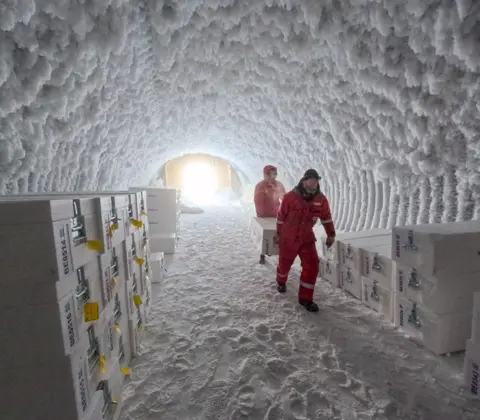
An international team of researchers has recovered the longest continuous climate record ever extracted from an Antarctic ice core, spanning 1.5 million years. Published in Nature, the findings provide an unbroken timeline of Earth’s atmospheric composition, temperature shifts, and greenhouse gas concentrations, offering critical clues to the mechanisms behind the planet’s most extreme ice ages.
The breakthrough, led by scientists from the University of Cambridge and the British Antarctic Survey, comes from a core drilled in East Antarctica’s Allan Hills Blue Ice Area. Unlike earlier cores that offered fragmented snapshots, this specimen delivers a seamless reconstruction of climate cycles, bridging the transition between the 41,000 year glacial periods of the early Pleistocene and the more intense 100,000 year cycles that followed.
What Happened
The research team analyzed trapped air bubbles and chemical signatures in the ice core to reconstruct past atmospheric conditions. Their analysis reveals key shifts in Earth’s climate system, including fluctuations in carbon dioxide and methane levels that align with glacial and interglacial periods. The data also highlights the role of ocean circulation, particularly the Atlantic Meridional Overturning Circulation (AMOC), in triggering and sustaining ice ages.
Why Public Health Officials Are Concerned
While modern climate change is driven by human activity, understanding natural climate variability is essential for distinguishing between human induced warming and natural cycles. The 1.5 million year record provides a baseline for testing climate models and identifying potential tipping points in Earth’s climate system. Public health and environmental agencies emphasize that this data will help refine predictions about future climate scenarios, including extreme weather events and long term ecological impacts.
Symptoms or Risk Factors
Although this study focuses on prehistoric climate patterns, the findings underscore the importance of monitoring current greenhouse gas levels and ocean circulation trends. Researchers warn that disruptions in these systems could accelerate climate change, with cascading effects on global health, food security, and ecosystem stability.
Who May Be Affected
Communities worldwide are already experiencing the consequences of climate change, including rising sea levels, extreme weather events, and shifts in agricultural productivity. The insights from this ice core could inform policies aimed at mitigating these impacts, particularly for vulnerable populations in coastal regions and areas prone to drought or flooding.
Government or WHO Response
International climate science bodies, including the Intergovernmental Panel on Climate Change (IPCC), have long emphasized the need for high resolution paleoclimate data to improve climate projections. The World Meteorological Organization (WMO) has highlighted the importance of such records in guiding global climate action and adaptation strategies. Governments are increasingly relying on these datasets to inform policies on emissions reduction, renewable energy adoption, and disaster preparedness.
Prevention and Safety Guidance
While the ice core itself does not directly inform public health interventions, the data it provides can guide long term climate resilience strategies. Researchers recommend integrating these findings into national climate adaptation plans, particularly for sectors vulnerable to climate variability, such as agriculture, water management, and public health infrastructure. The study also underscores the need for continued investment in climate science and international collaboration to address the challenges posed by both natural and human induced climate change.
What Readers Should Know
The 1.5 million year climate record from Antarctica offers a rare glimpse into Earth’s past, revealing how natural forces shaped the planet’s climate over millennia. For policymakers, the data provides a critical tool for refining climate models and developing strategies to address future warming. For the public, it serves as a reminder of the interconnectedness of Earth’s systems and the importance of sustainable practices in mitigating climate risks.
Key Takeaways
- The 1.5 million year Antarctic ice core provides the longest continuous climate record ever recovered, offering unprecedented insights into Earth’s glacial cycles.
- Researchers identified key shifts in greenhouse gas dynamics and ocean circulation as primary drivers of past ice ages.
- The findings will help refine climate models and distinguish between natural climate variability and human induced warming.
- Public health and environmental agencies can use this data to inform policies on climate adaptation and disaster preparedness.
- Continued investment in paleoclimate research is essential for addressing future climate challenges.
Frequently Asked Questions
How does this ice core differ from previous climate records?
Unlike earlier cores that provided fragmented glimpses into the past, this specimen delivers a seamless timeline spanning 1.5 million years, covering the transition between 41,000 year and 100,000 year glacial cycles.
What role do greenhouse gases play in glacial cycles?
The ice core data show that fluctuations in carbon dioxide and methane levels correlate with glacial and interglacial periods, suggesting a feedback loop where declining CO₂ may have amplified cooling during ice ages.
How will this research impact future climate modeling?
The findings provide a robust dataset for testing and improving climate models, helping scientists distinguish between natural climate variability and human induced warming.
What are the next steps for this research?
Researchers plan to drill deeper into the Antarctic ice sheet, potentially reaching back 2 million years or more, and integrate these findings with sediment and speleothem records for a multi proxy reconstruction of past climates.
Why is this discovery significant for public health?
Understanding natural climate variability is essential for distinguishing between human induced warming and natural cycles, which can inform policies on climate adaptation and disaster preparedness.
Medical Review: MedSense Editorial Board












DISCUSSION (0)
POST A COMMENT