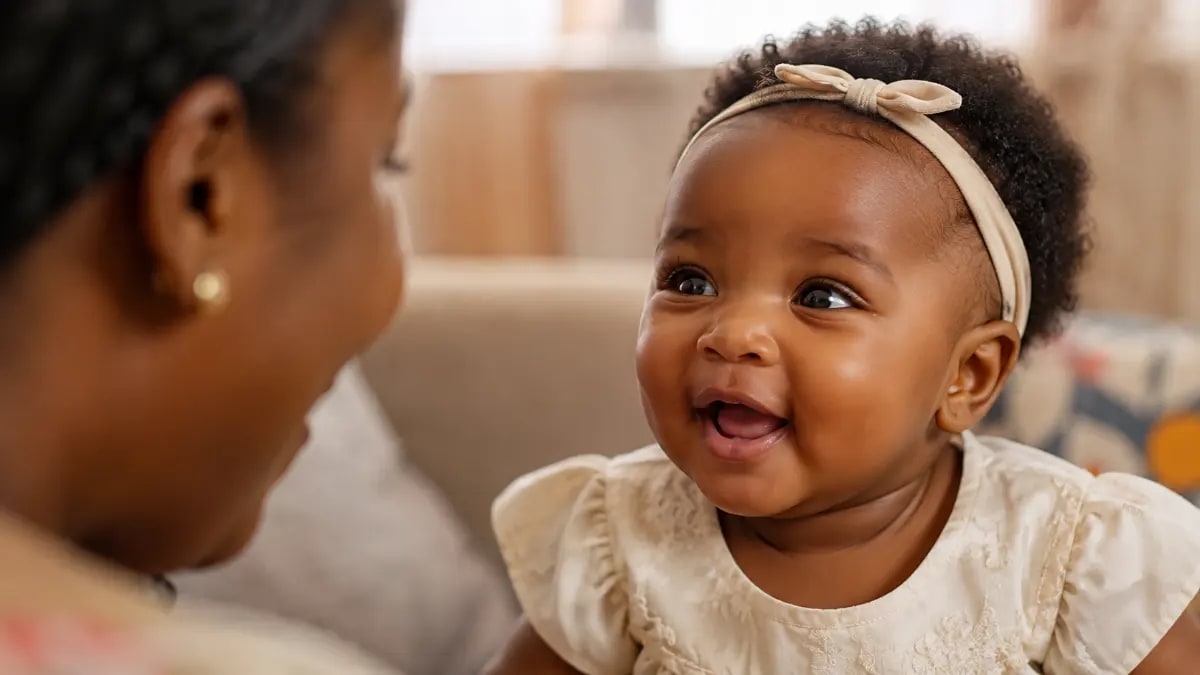
Infants engage in conversational exchanges with adults long before speaking their first words, according to new research. These early vocal interactions, where adults respond to coos and babbles with exaggerated intonation, play a crucial role in teaching babies the fundamentals of conversation. The study, co authored by Florida International University professor Martha Pelaez, highlights how immediate adult responses shape infant speech development during critical early months.
What We Know
Babies begin practicing conversation months before uttering their first recognizable words. A new study reveals that these early vocal exchanges, where adults respond to infant coos, babbles, and squeals with exaggerated, high pitched speech, serve as foundational training for language development.
Research co authored by Martha Pelaez, a professor of education at Florida International University, shows that these back and forth interactions are not just playful but essential. When adults immediately reply to an infant’s vocalizations, they reinforce the baby’s understanding of turn taking, a core component of conversation. This process helps infants grasp the rhythm and structure of communication long before they can form sentences.
The findings emphasize that even pre verbal infants are active participants in social exchanges. Their coos and babbles are not random noises but early attempts at communication, met with responses that shape their linguistic growth.
Why This Matters
Early vocal interactions between infants and caregivers have long term implications for language acquisition and cognitive development. Studies suggest that babies who experience frequent, responsive vocal exchanges tend to develop larger vocabularies and stronger communication skills as toddlers. These interactions also foster emotional bonding, as infants learn to associate vocalizations with attention and care.
The research underscores the importance of parental responsiveness in early childhood. While baby talk, characterized by higher pitch and exaggerated intonation, may seem simplistic, it plays a critical role in capturing an infant’s attention and modeling conversational patterns. Parents and caregivers who engage in these exchanges are unknowingly laying the groundwork for their child’s future language abilities.
Expert Perspective
Martha Pelaez, a leading researcher in early childhood education, notes that these early interactions are more than just adorable moments. "Adults are not just responding to noise, they are teaching babies the rules of conversation," she explains. "Every coo and babble is an opportunity to reinforce turn taking, which is fundamental to language development."
Pelaez’s work aligns with broader research on infant directed speech, which shows that babies prefer and respond more actively to higher pitched, melodic voices. This preference is not just a quirk of infancy but a biological adaptation that supports learning.
Public Health Impact
The study’s findings have implications for public health initiatives aimed at supporting early childhood development. Programs that educate parents about the importance of responsive communication, such as talking, singing, and reading to infants, could help bridge gaps in language development, particularly in underserved communities.
Pediatricians and child development experts often recommend that caregivers engage in frequent, high quality interactions with infants, even before they can speak. These interactions are linked to better cognitive outcomes, including improved problem solving skills and emotional regulation. The new research reinforces these recommendations, highlighting that every vocal exchange counts.
What’s Next
Further research is needed to explore how variations in early vocal interactions, such as frequency, tone, and responsiveness, affect long term language outcomes. Scientists are also investigating whether cultural differences in infant directed speech influence developmental trajectories.
For parents and caregivers, the takeaway is clear: responding to an infant’s vocalizations, no matter how simple, is a powerful tool for fostering communication skills. These early conversations may be wordless, but their impact lasts a lifetime.
Key Takeaways
- Babies engage in conversational exchanges with adults long before speaking their first words, learning turn taking through vocal interactions.
- Immediate adult responses to infant coos and babbles reinforce language development and emotional bonding.
- Public health programs could leverage these findings to promote early communication skills, particularly in underserved communities.
Frequently Asked Questions
Why do adults use baby talk with infants?
Baby talk, with its higher pitch and exaggerated intonation, captures an infant’s attention and models conversational patterns, supporting language development.
How early do these vocal exchanges begin?
These interactions start in the first months of life, long before babies can form words, as infants begin to coo and babble in response to adult voices.
Do all cultures use baby talk with infants?
While the style of infant directed speech varies across cultures, most societies use some form of exaggerated, melodic speech to engage babies.
Published by O. Ayodeji | Review by MedSense Editorial Board
























DISCUSSION (0)
POST A COMMENT