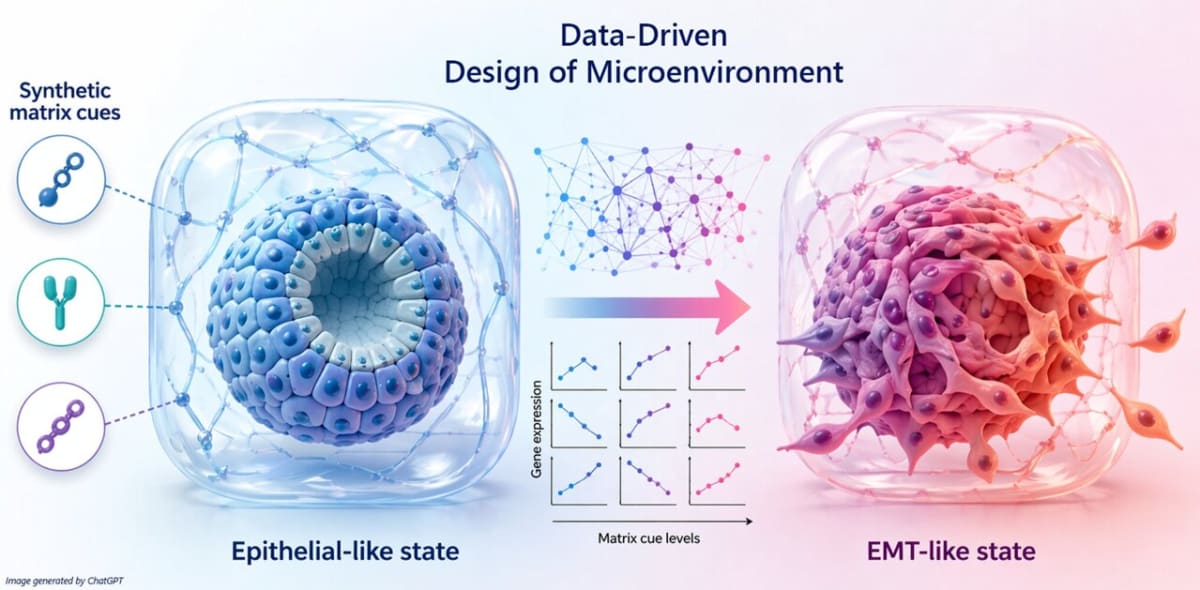
Researchers at the Leibniz Institute of Polymer Research Dresden have achieved a significant milestone in cancer biology by developing a data driven approach to manipulate pancreatic cancer organoids, steering them into previously unobserved cell states. Published in Advanced Materials, their study introduces engineered biomaterials that act as precise tools to guide cellular transitions, providing a novel framework for understanding tumor heterogeneity and progression. This work could redefine how scientists study pancreatic cancer, a disease notorious for its aggressive nature and resistance to conventional therapies.
Clinical Significance
Pancreatic ductal adenocarcinoma, the most common form of pancreatic cancer, remains one of the deadliest malignancies worldwide, with a five year survival rate below 10%. A major obstacle in treating this disease is the remarkable plasticity of cancer cells, which allows them to adapt to environmental pressures and evade therapies by transitioning between distinct cellular states. The ability to control these transitions could unlock new therapeutic avenues, enabling researchers to either stabilize less aggressive states or push cells toward states more vulnerable to treatment.
Deep Dive and Research Findings
The study, led by researchers at the Leibniz Institute of Polymer Research Dresden, leverages a combination of high throughput screening and machine learning to design biomaterials that interact with pancreatic cancer organoids in highly specific ways. Unlike traditional two dimensional cell cultures, organoids, three dimensional clusters of cancer cells, mimic the complex architecture and behavior of tumors more accurately. The team engineered biomaterials with tailored mechanical properties and biochemical cues to influence how these organoids evolve over time.
By analyzing vast datasets of cellular responses, the researchers identified patterns that predict how different biomaterial environments drive organoids into distinct cell states. This data driven approach allowed them to fine tune the biomaterials' properties, effectively steering the organoids toward states that either resemble normal pancreatic tissue or exhibit heightened aggressiveness. The findings highlight the potential of biomaterials not just as passive scaffolds but as active modulators of cellular behavior.
Future Outlook and Medical Implications
The implications of this research extend beyond pancreatic cancer. The methodology developed by the team could be adapted to study other solid tumors characterized by cellular plasticity, such as breast or prostate cancer. Additionally, the engineered biomaterials could serve as platforms for drug screening, enabling researchers to test therapies against specific cancer cell states in a controlled environment. Long term, this work may contribute to the development of personalized medicine strategies, where treatments are tailored to the unique cellular states of a patient's tumor.
While the study is still in its early stages, the integration of biomaterials science with cancer biology represents a promising frontier. The ability to manipulate cell states in organoids could accelerate the discovery of new drug targets and biomarkers, ultimately improving outcomes for patients facing some of the most challenging cancers.
Patient or Practitioner Guidance
For clinicians and researchers, this study underscores the importance of adopting advanced models like organoids in cancer research. Traditional cell cultures often fail to capture the complexity of tumors, leading to gaps between laboratory findings and clinical outcomes. By incorporating engineered biomaterials into their workflows, scientists may gain deeper insights into tumor biology and identify more effective therapeutic strategies.
Patients and advocates should note that while this research is a step forward, translating these findings into clinical practice will require further validation and testing. The development of new therapies based on this approach could take years, but the potential to address the unmet needs of pancreatic cancer patients makes it a critical area of focus for the medical community.
Key Takeaways
- Engineered biomaterials can actively steer pancreatic cancer organoids into distinct cell states, offering a new tool to study tumor heterogeneity.
- The study combines high throughput screening and machine learning to design biomaterials that precisely modulate cellular behavior.
- This approach could accelerate drug discovery and personalized medicine by providing more accurate tumor models for research.
- Pancreatic cancer's aggressiveness and resistance to therapy may be better understood through the lens of cellular plasticity, which this research helps illuminate.
Frequently Asked Questions
How do engineered biomaterials influence cancer cell states in organoids?
The biomaterials are designed with specific mechanical and biochemical properties that interact with the organoids, guiding their transition into different cell states. By analyzing cellular responses through high throughput screening and machine learning, researchers can predict and control these transitions.
What makes pancreatic cancer organoids a better model than traditional cell cultures?
Organoids are three dimensional structures that more closely mimic the architecture and behavior of actual tumors. This allows researchers to study cancer biology in a context that better reflects the complexity of human tumors, including their heterogeneity and adaptive responses to treatments.
Could this technology be used to treat pancreatic cancer in patients?
While the study represents a significant advancement in understanding tumor biology, translating these findings into clinical practice will require further research and validation. The biomaterials could eventually inform the development of new therapies, but this process will likely take years.
How might this approach benefit other types of cancer?
The methodology developed in this study could be adapted to investigate other solid tumors characterized by cellular plasticity, such as breast or prostate cancer. The principles of using biomaterials to modulate cell states may offer insights into a wide range of malignancies.
Medical Review: MedSense Editorial Board























DISCUSSION (0)
POST A COMMENT