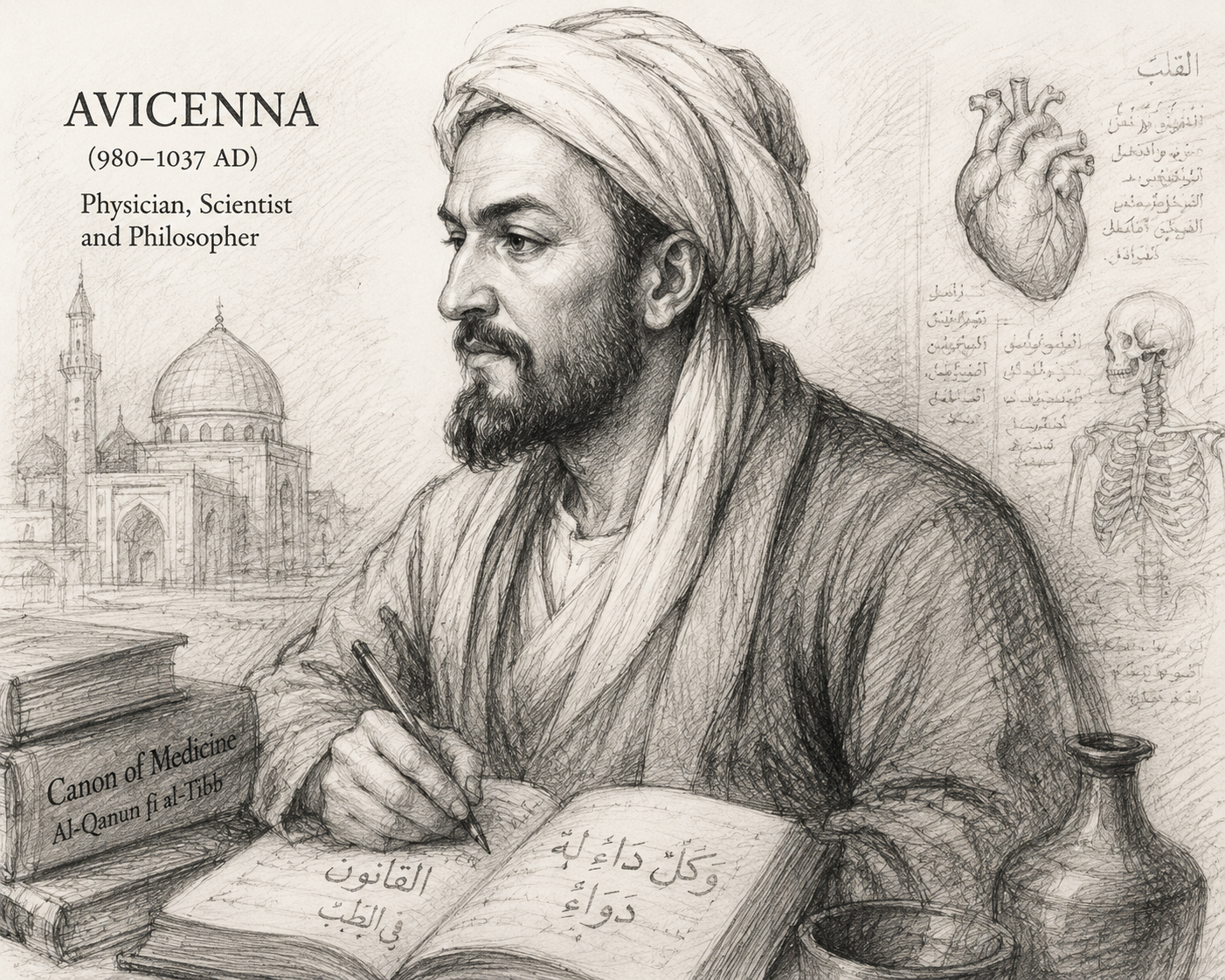
Who Was Avicenna?
Avicenna, full name Abu Ali al Husayn ibn Abd Allah ibn Sina, was born in 980 CE in the village of Afshana, near Bukhara in present day Uzbekistan. From a young age, he displayed an extraordinary intellect, mastering subjects like logic, mathematics, and medicine by his teenage years. By the age of 16, he was already treating patients and studying advanced medical texts. His insatiable curiosity and dedication to learning led him to become one of the most prolific scholars of the Islamic Golden Age, a period spanning the 8th to 14th centuries when science, philosophy, and medicine flourished in the Islamic world.
Avicenna’s life was marked by both intellectual brilliance and political turbulence. He served as a physician and advisor to various rulers, including the Samanid and Buyid dynasties, while also navigating the complexities of court politics. Despite these challenges, he produced an astonishing body of work, with estimates suggesting he wrote over 450 books on a wide range of topics, from medicine and philosophy to astronomy and poetry. Of these, around 240 survive today, with his medical writings being the most enduring.
The Canon of Medicine: A Masterpiece of Medical Literature
Avicenna’s most famous work, The Canon of Medicine (Al Qanun fi al Tibb), is a five volume encyclopedia that synthesized the medical knowledge of his time while introducing original insights. Completed around 1025 CE, the Canon drew from Greek, Roman, Persian, and Indian medical traditions, including the works of Hippocrates, Galen, and Sushruta. However, Avicenna did not merely compile existing knowledge; he critically evaluated it, corrected errors, and added his own observations and theories.
The Canon is structured systematically, covering topics such as anatomy, physiology, diagnosis, treatment, and pharmacology. It begins with general principles of medicine, including the importance of hygiene, diet, and environmental factors in health. Avicenna then delves into the causes and symptoms of diseases, offering detailed descriptions of conditions like diabetes, meningitis, and tuberculosis. One of his most notable contributions was his emphasis on clinical observation and experimentation, a precursor to the scientific method. For example, he described the contagious nature of tuberculosis and the role of contaminated water in spreading diseases, ideas that were revolutionary for his time.
The Canon also included a comprehensive pharmacopeia, listing over 760 drugs and their uses. Avicenna classified medications based on their effects, such as analgesics, antiseptics, and diuretics, and provided guidelines for their preparation and administration. His work on pharmacology was so advanced that it remained a standard reference in European medical schools until the 17th century. The Canon was translated into Latin in the 12th century and became a foundational text in medieval European universities, influencing figures like William Harvey and Andreas Vesalius.
Avicenna’s Medical Innovations and Theories
Beyond the Canon, Avicenna made several groundbreaking contributions to medicine that demonstrated his forward thinking approach. One of his most significant innovations was his theory of contagion, which predated the germ theory of disease by centuries. He proposed that certain diseases could spread through invisible particles in the air or through contact with infected individuals or objects. This idea laid the groundwork for later understandings of infectious diseases and public health measures.
Avicenna also advanced the field of psychology and mental health, recognizing the connection between the mind and body. In the Canon, he described conditions like depression, anxiety, and insomnia, and advocated for holistic treatments that included psychotherapy, music therapy, and lifestyle modifications. His approach to mental health was remarkably progressive, emphasizing the importance of emotional well being in overall health.
In anatomy and physiology, Avicenna provided detailed descriptions of the human body, including the structure and function of organs like the heart, lungs, and brain. He correctly identified the heart as the center of the circulatory system and described the role of the lungs in oxygenating the blood. While some of his anatomical descriptions were later refined by Renaissance scientists, his work was a critical step in moving away from the humoral theory of medicine toward a more evidence based understanding of the body.
Avicenna’s Influence on Modern Medicine
Avicenna’s impact on medicine extends far beyond the medieval period. The Canon of Medicine was used as a textbook in European medical schools for over 600 years, and its influence can be seen in the development of modern medical education. For example, his emphasis on clinical observation and systematic diagnosis became a cornerstone of medical training, shaping how physicians approach patient care today. The Canon also introduced the concept of clinical trials, where Avicenna recommended testing the efficacy of drugs on animals and humans before widespread use, a practice that remains fundamental in modern pharmacology.
In the Islamic world, Avicenna’s legacy is equally profound. His works were studied and expanded upon by later scholars, including Ibn al Nafis, who discovered the pulmonary circulation of blood. Avicenna’s holistic approach to medicine, which considered the physical, emotional, and environmental factors affecting health, continues to resonate in contemporary integrative and preventive medicine. His ideas about the importance of hygiene, diet, and mental well being align with modern public health principles, reinforcing the timelessness of his contributions.
Today, Avicenna is celebrated as a symbol of the Islamic Golden Age and a pioneer of early modern medicine. His name is honored in medical institutions around the world, including the Avicenna Directories, a World Health Organization project that catalogs medical schools globally. His life and work serve as a reminder of the power of curiosity, critical thinking, and cross cultural exchange in advancing human knowledge.
Why Avicenna’s Work Still Matters Today
In an era where medical knowledge is rapidly evolving, it can be easy to overlook the contributions of ancient scholars. However, Avicenna’s work remains relevant for several reasons. First, his emphasis on evidence based medicine and clinical observation laid the foundation for the scientific approach to healthcare that we rely on today. His insistence on questioning established theories and seeking empirical proof is a principle that continues to drive medical research and innovation.
Second, Avicenna’s holistic approach to health serves as a valuable reminder of the importance of treating the whole person, not just the disease. In a time when medicine is increasingly specialized, his work encourages healthcare providers to consider the broader context of a patient’s life, including their environment, emotions, and lifestyle. This perspective is particularly relevant in the growing fields of integrative and preventive medicine, where the goal is to promote long term well being rather than just treating symptoms.
Finally, Avicenna’s life story is a testament to the power of intellectual curiosity and resilience. Despite living in a time of political instability and personal hardship, he produced work that transcended his era and continues to inspire. His ability to synthesize knowledge from diverse cultures and disciplines demonstrates the importance of collaboration and open mindedness in advancing science and medicine. For students, researchers, and healthcare professionals, Avicenna’s legacy is a call to embrace lifelong learning and to approach challenges with creativity and determination.
Exploring Avicenna’s Legacy Further
For those interested in learning more about Avicenna, his works are widely available in translation, and many libraries and universities offer resources on his contributions to medicine and philosophy. The Canon of Medicine is particularly accessible, with annotated editions that provide context for his theories and their relevance to modern medicine. Additionally, museums and cultural institutions in countries like Iran, Uzbekistan, and Turkey often feature exhibits on Avicenna and the Islamic Golden Age, offering a deeper appreciation for his impact on history.
Avicenna’s story is also a reminder of the rich history of medicine and the contributions of scholars from diverse backgrounds. By studying his work, we gain not only a deeper understanding of the past but also insights that can inform the future of healthcare. Whether you are a medical professional, a student, or simply someone interested in the history of science, Avicenna’s legacy offers valuable lessons and inspiration.
Key Takeaways
- Avicenna, also known as Ibn Sina, was a Persian polymath whose work in medicine, philosophy, and science shaped early modern medicine and influenced healthcare for centuries.
- His most famous work, The Canon of Medicine, was a five volume encyclopedia that synthesized medical knowledge from Greek, Roman, Persian, and Indian traditions while introducing original insights and theories.
- The Canon covered topics such as anatomy, physiology, diagnosis, treatment, and pharmacology, and it remained a standard medical textbook in European universities until the 17th century.
- Avicenna made groundbreaking contributions to medicine, including theories on contagion, mental health, and clinical observation, many of which predated modern medical discoveries by centuries.
- His holistic approach to health, which considered physical, emotional, and environmental factors, continues to resonate in contemporary integrative and preventive medicine.
- Avicenna’s emphasis on evidence based medicine, clinical trials, and systematic diagnosis laid the foundation for the scientific approach to healthcare that is still used today.
- His legacy is celebrated worldwide, with institutions like the World Health Organization honoring his name through projects like the Avicenna Directories, which catalog medical schools globally.
Frequently Asked Questions
What is Avicenna best known for?
Avicenna is best known for his encyclopedic work The Canon of Medicine, which synthesized medical knowledge from diverse traditions and introduced original theories. The Canon became a foundational text in medical education and remained influential for over 600 years. He is also celebrated for his contributions to philosophy, psychology, and the scientific method.
How did Avicenna influence modern medicine?
Avicenna’s influence on modern medicine is vast. His emphasis on clinical observation, evidence based practice, and systematic diagnosis shaped the development of medical education and practice. The Canon of Medicine introduced concepts like clinical trials and the importance of testing drugs before widespread use, principles that remain fundamental in modern pharmacology. His holistic approach to health also aligns with contemporary integrative medicine.
What were some of Avicenna’s key medical theories?
Avicenna proposed several groundbreaking theories, including the idea that certain diseases could spread through contagion, predating the germ theory of disease. He also advanced the understanding of mental health, describing conditions like depression and anxiety and advocating for holistic treatments. Additionally, he provided detailed descriptions of anatomy and physiology, including the role of the heart and lungs in circulation.
Why is The Canon of Medicine still relevant today?
The Canon of Medicine remains relevant because it introduced principles that are still central to modern medicine, such as evidence based practice, clinical observation, and the importance of hygiene and diet in health. Its systematic approach to diagnosis and treatment influenced medical education for centuries, and its holistic perspective continues to resonate in contemporary healthcare.
How can I learn more about Avicenna’s work?
To learn more about Avicenna, you can explore translated editions of The Canon of Medicine, which are widely available in libraries and online. Many universities and cultural institutions also offer resources on his contributions to medicine and philosophy. Museums in countries like Iran, Uzbekistan, and Turkey often feature exhibits on Avicenna and the Islamic Golden Age, providing further insights into his legacy.
Medical Review: MedSense Editorial Board
DISCUSSION (0)
POST A COMMENT